Graphic Designer Resume Template

The Best Resume for Graphic Designers

Yes, we know. You're a designer. Your instinct is to make the resume a piece of craft. We're here to tell you — respectfully, and with full appreciation for your taste — that the cleanest resume you'll ever design is also the one with no design on it at all. From executive recruiters who've hired creative directors at agencies, in-house teams, and the companies that actually set the visual standards everyone else copies.
Upload My Resume Start with LinkedIn Start from Scratch
4.9★
Average rating
7M+
Resumes created
10 sec
To impress a screener
👩
JESSICA LANG
💻 Software Developer
🌟 Skills
JavaScript★★★★★
React★★★★☆
Leadership★★★★★
📬 Contact
📱 (123) 456-7890
🏆 Awards
🥇 Employee of Month
Jessica Lang
Passionate & Innovative | Problem Solver | Team Player | Change Maker
💡 Creative🚀 Motivated
Results-driven professional with a demonstrated history of delivering impactful solutions. Passionate about leveraging synergistic technologies.
💼 Experience
⚡ Role Title
🏢 Some Company · Jan 2021–Present
Collaborated cross-functionally with diverse stakeholders
Leveraged cutting-edge best practices and agile methodologies
🛠️ Skills
💚 Skill A💚 Skill B💚 Skill C
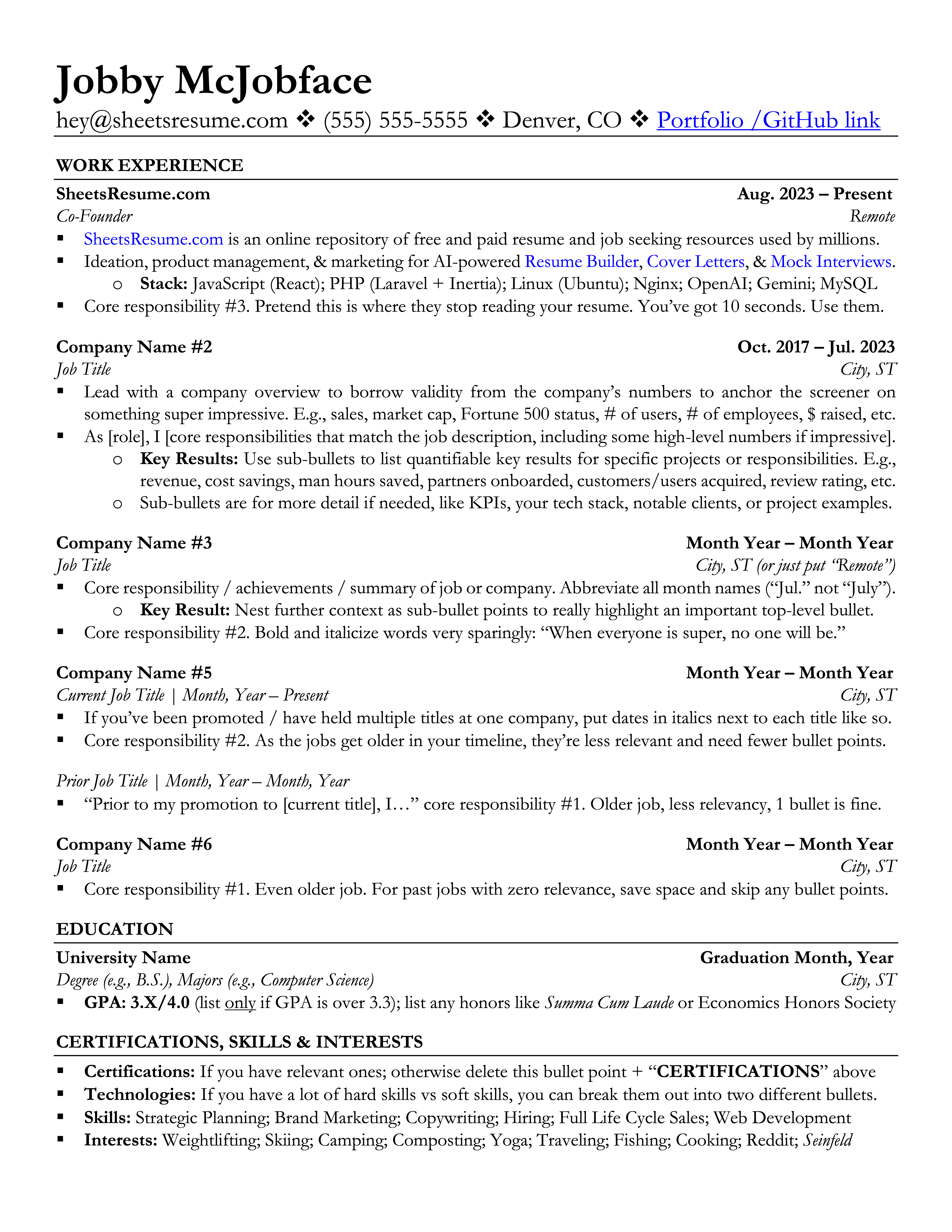
Sheets Resume Template
Before — the resume that gets ignored
After — click to build yours in seconds! ↑
The 10-Second Rule

What a creative hiring manager's eyes jump to, in order of importance:

The screener for a design role is often a recruiter or HR generalist first — not a creative director. They're looking for signal that you belong in the YES pile before your portfolio ever gets opened. And they're trying to do it in ten seconds, because there's a stack. The portfolio does the creative heavy lifting. The resume just needs to get you to the portfolio.

What a screener processes in under 10 seconds:
① Portfolio Link
Behance? Personal site? Dribbble?
Put it in your header, prominently. Your portfolio is your actual resume — the text document is just the cover charge to get it opened. Make the URL clean and memorable; a messy link is its own design failure.
The Real Interview Maker
② Employer
BBDO? Apple? A funded startup?
Who you've worked for tells the screener everything about the caliber of problems you've solved and the standards you've been held to. A company overview bullet helps if your employer isn't a household name — borrow their credibility.
Borrowed Validation
③ Title
Senior? Art Director? CD? VP?
Level matters. "Graphic Designer" and "Senior Brand Designer" are the same job to the untrained eye but completely different signals to anyone who's hired creatives. Make sure your title reflects your actual seniority and aligns with the roles you're applying for.
Level = Signal
④ Skills
Figma · Adobe CC · Motion · Brand Systems
Lead with tools the job posting specifically mentions. Figma vs. Illustrator vs. After Effects signals very different things. Don't bury the lede — put the most relevant tools first and tailor per application.
Tool Stack = Keyword Match
⑤ The One Thing Your Resume Isn't
Your resume is not a portfolio. It's not a creative brief. It's not proof of your taste. It is a blunt, functional instrument whose only job is to get someone to open your portfolio link. That's it. Save the craft for the work.
Every design instinct you have — to add hierarchy with color, to differentiate yourself with layout, to signal your aesthetic — actively works against you on a resume. A screener seeing a two-column designed resume thinks "this person doesn't know the rules," not "what beautiful typography." Clean text. One column. Then let your actual work do the talking.
Get the Interview
What actually works

✅ DO THIS on your graphic designer resume

  • Put your portfolio URL in your header — make it clickable and clean.
  • Include a company overview bullet for each employer, especially agencies.
  • List tools in a Skills section: Software → Disciplines → Industries → Skills
  • Quantify where you can (brand reach, campaign impressions, team size you led).
  • Keep it to one page unless you're a director or above.
  • End with an Interests line — "photography, type nerd, bouldering" lands better in creative interviews than you'd think.

❌ NEVER DO THIS

  • Do NOT design your resume. A two-column, colored, icon-laden resume reads as someone who didn't get the memo — no matter how good it looks.
  • Don't list software you haven't touched in years. "Quark XPress" is not a flex.
  • No summaries. "Passionate visual storyteller who…" is the fastest way to get skipped.
  • Don't put your portfolio link only at the bottom. It's the whole point — it goes in the header.
  • Don't send a PDF portfolio without a web portfolio. Screeners won't open a 50MB attachment.
  • Don't omit the industries you've worked in — retail vs. tech vs. pharma is real signal for hiring managers.
"
This tool is so helpful, it actually makes the most boring thing on Earth (preparing CVs) a bit fun with its step-by-step guide. Wish I'd known about it a few days ago before sending my dream job application with that ugly ass CV.
Irena · System Analyst
Common questions

Best Graphic Designer Resume FAQ

Answered honestly by Colin McIntosh, founder of Sheets Resume Builder and full-time executive recruiter.

Should I use an "infographic" or designed resume as a graphic designer?
No — and this is the hill we will die on. We understand the appeal. You're a designer. The resume feels like a canvas. But the screener receiving your resume is almost certainly not a designer, and a designed resume does not impress a non-designer. It reads as: this person doesn't know the rules. Worse, multi-column and graphic-heavy resumes frequently get mangled by ATS systems, meaning the actual engineer or creative director down the line may never even see your formatted masterpiece. Save the craft for the portfolio. The resume is just a key to open that door.
How do I list freelance or contract design work on my resume?
List it as a role, just like any other job. "Freelance Graphic Designer — Self-Employed, 2021–Present" is totally legitimate. The question is whether you go deeper: if you've done brand work for recognizable clients, name them. "Clients included Nike, Warby Parker, and Patagonia" as a bullet point is a huge deal. If your clients are smaller, lead with the work type and industry: "Brand identity, packaging, and campaign design for DTC e-commerce clients." One thing to avoid: listing 40 tiny freelance gigs individually. Group them under one umbrella role unless one of them is legitimately impressive enough to warrant its own entry.
What's the right length for a designer resume?
One page for most people, full stop. The exception is creative directors or VPs of Design with 10+ years of experience, who can justify two pages. If you're entry or mid-level, you don't have enough experience to need two pages, and a second page isn't doing you any favors — it's just making the screener work harder to find the good stuff. One page. Dense and good. Let the portfolio go long.

Build your graphic designer resume in minutes, or even seconds. (Actually.)

Used by designers at agencies, in-house teams, FAANG, and studios of all sizes. Start from any resume, your LinkedIn URL, or from scratch. 4.9 Star Rating, free to try, and no-questions refunds if you don't love it.

Build My Resume with AI 4.9/5 ⭐ Peruse Reviews