Entrepreneur & Founder Resume Template

The Best Resume for Entrepreneurs & Founders

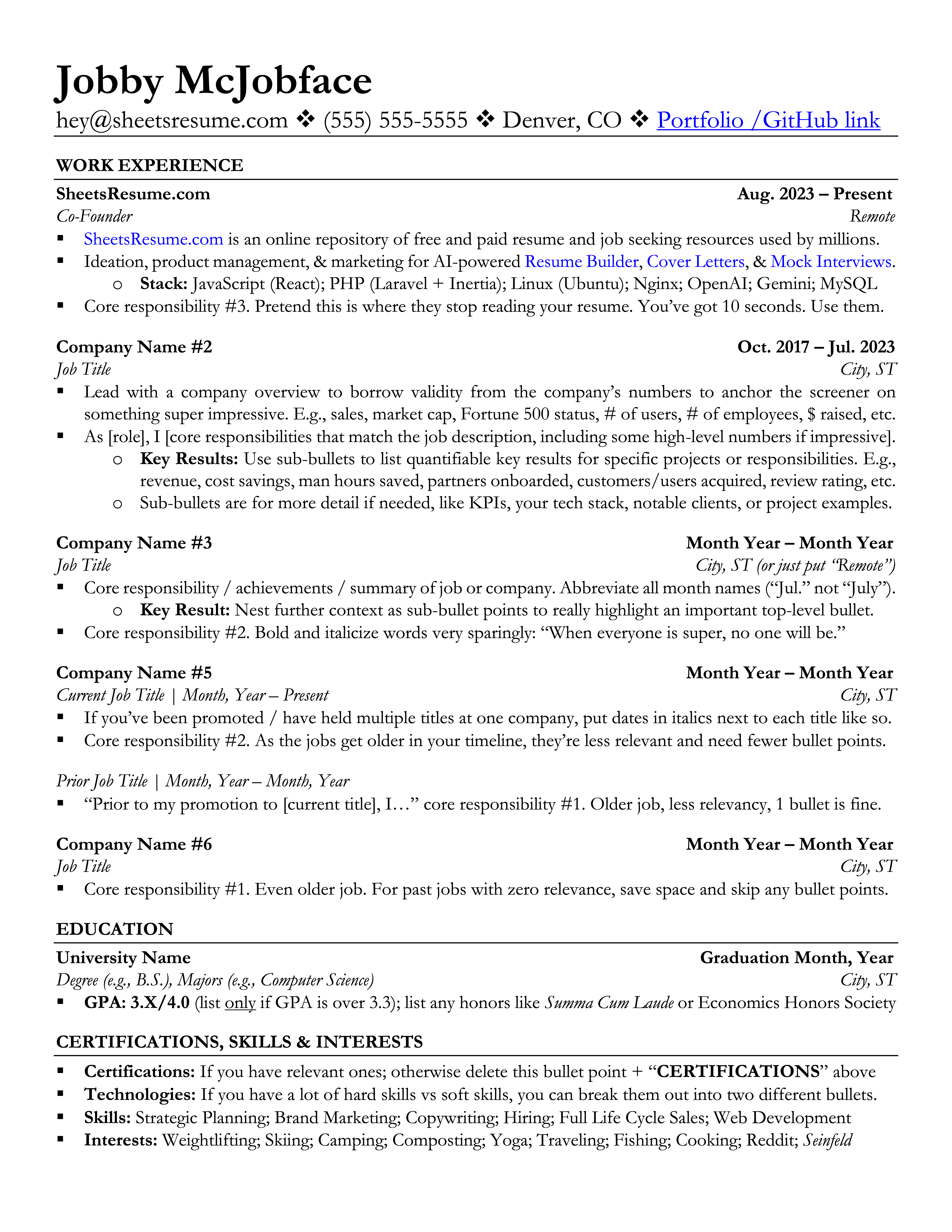
Transitioning from founder to employee is one of the most misunderstood moves in job searching. You ran a company. You made every decision, wore every hat, and probably failed at half of it before you figured out the other half. The challenge on a resume is that "founder" is simultaneously the most impressive and most confusing title a screener can encounter. Let's demystify it. From executive recruiters who've placed founders into operating roles at companies that knew exactly what they were getting.
Upload My Resume Start with LinkedIn Start from Scratch
4.9β˜…
Average rating
7M+
Resumes created
10 sec
To impress a screener
πŸ‘©
JESSICA LANG
πŸ’» Software Developer
🌟 Skills
JavaScriptβ˜…β˜…β˜…β˜…β˜…
Reactβ˜…β˜…β˜…β˜…β˜†
Leadershipβ˜…β˜…β˜…β˜…β˜…
πŸ“¬ Contact
πŸ“± (123) 456-7890
πŸ† Awards
πŸ₯‡ Employee of Month
Jessica Lang
Passionate & Innovative | Problem Solver | Team Player | Change Maker
πŸ’‘ CreativeπŸš€ Motivated
Results-driven professional with a demonstrated history of delivering impactful solutions. Passionate about leveraging synergistic technologies.
πŸ’Ό Experience
⚑ Role Title
🏒 Some Company Β· Jan 2021–Present
Collaborated cross-functionally with diverse stakeholders
Leveraged cutting-edge best practices and agile methodologies
πŸ› οΈ Skills
πŸ’š Skill AπŸ’š Skill BπŸ’š Skill C
Sheets Resume Template
⚑
Before β€” the resume that gets ignored
After β€” click to build yours in seconds! ↑
The 10-Second Rule

What a screener looks for on a founder's resume:

Founder experience is compelling but often poorly communicated. The screener reviewing your resume knows you started something. What they don't know β€” and desperately need to understand β€” is how big it was, whether it worked, what specifically you did, and whether you can operate within a structure and alongside other people rather than at the top of one. Your resume's job is to answer all four of those questions before anyone has to ask.

What a screener processes in under 10 seconds:
β‘  Company Scale
Revenue? Funding? Customers? Employees?
The first question any screener has about founder experience is: how big was it? A $10M revenue business and a side project with $20K in sales are both "founder" experiences. Put the numbers upfront in a company overview bullet: ARR, total revenue, funding raised, customers, team size. Don't make them guess.
Scale = Legitimacy
β‘‘ Your Specific Role
What did YOU actually do, day-to-day?
"Founder & CEO" says you started something. It doesn't say whether you were the product person, the sales person, the operator, or the fundraiser. Your bullets need to make your actual functional contributions explicit β€” especially for the skills that are most relevant to the role you're applying for now.
Function Over Title
β‘’ Outcomes
Growth Β· Exit Β· Revenue Β· Customers Built
What did the company accomplish while you were leading it? Revenue growth, user acquisition, a successful exit, a pivot that worked β€” these are your achievement bullets. If the company didn't succeed, you can still quantify what you built before it didn't: peak ARR, total customers, capital raised.
Output = Credibility
β‘£ Pre-Founder Experience
Where did you work before you took the leap?
If you have strong pre-founder experience at recognizable companies, don't let your founder role eclipse it entirely. The combination of "worked at Google, then built and sold a company" is incredibly compelling. Present both β€” your past gives context to why you were able to found something at all.
Pedigree + Founder = Powerful
β‘€ The Founder's Honest Challenge
Every screener has one unspoken concern about founders: can they work for someone else? Your resume doesn't answer that question β€” but it needs to not raise it either. Concrete function, clear scope, honest outcomes.
Don't oversell and don't undersell. "Built and sold a $3M ARR business over 5 years" is honest and impressive. "Disrupted the legacy industry through innovative synergistic solutions" is noise. The screener wants to know what you actually did and whether it worked. Tell them directly. Save the vision for the interview.
Honesty = Trust
What actually works

βœ… DO THIS on your entrepreneur & founder resume

  • Include a company overview bullet with your venture's scale: revenue, funding, team, customers.
  • Break your role into functional bullet points β€” what did you personally own and deliver?
  • Quantify your outcomes honestly. Peak revenue, customers acquired, capital raised.
  • Don't hide prior corporate experience β€” present it alongside your founder experience.
  • Tailor your bullets to emphasize the function most relevant to the role you're applying for.
  • If your company exited, say so and say how (acqui-hire, acquisition, IPO, wind-down).

❌ NEVER DO THIS

  • Don't oversell your company's scale. Screeners will verify.
  • No summaries. "Serial entrepreneur and visionary leader…" is the fastest way to lose a screener.
  • Don't omit what happened to the company. Screeners will look it up. Get ahead of it.
  • Don't list every hat you wore in a generic way. "Wore many hats" is not a bullet point.
  • Don't use a multi-column or styled template. Clean is the only format that survives both ATS and human review.
  • Don't pretend the company was bigger than it was. Interviewers who've been founders will know immediately.
"
I have probably been involved with many AI tools over the years. I can easily say, this tool is less AI and more human + AI. What it does best is give you an output you can be proud and confident of using to apply for that 100th application.
Shantanu Β· Job Seeker & Former Self-Employed
Common questions

Best Entrepreneur & Founder Resume FAQ

Answered honestly by Colin McIntosh, founder of Sheets Resume Builder and full-time executive recruiter.

How do I list my company on my resume if it failed?
Honestly and specifically. You don't need to announce that it failed β€” you need to describe what you built and what happened, without being evasive. "Founded and operated [Company], a B2B SaaS platform for [use case]; grew to $450K ARR and 80 customers before winding down in 2024" is a clean, honest treatment. Screeners and hiring managers β€” especially at startups β€” genuinely respect failed ventures that were run with integrity. What they don't respect is someone who's vague about a gap in their history, because that reads as embarrassment, and embarrassment reads as something to hide.
Should I include my founder experience if I'm applying for an individual contributor role?
Yes, but frame it functionally. If you're applying for a Head of Growth role, your bullets should emphasize the growth and marketing work you did at your company, not your board management or fundraising. The functional reframe is everything. "Founded and built a DTC e-commerce company" is less useful to a hiring manager than "Built and managed all paid acquisition, growing from $0 to $1.2M GMV in 18 months as sole growth operator." Same experience, completely different signal.
How do I address the "can they work for someone else?" concern that every hiring manager has?
You mostly address it in the interview, not the resume. But the resume helps by being specific and humble β€” functional bullets that describe what you did, not just what you envisioned, signal operational ability. In interviews, the answer is usually to be direct: "I loved building from zero, and I also genuinely enjoy operating within a structure where I can go deep on one thing."

Build your founder resume in minutes. The format that works for operators works for founders too β€” you just need to translate what you built into language a screener can evaluate in ten seconds.

Used by founders and entrepreneurs transitioning into executive and operator roles at startups and established companies. Start from any resume, your LinkedIn URL, or from scratch. 4.9 Star Rating, free to try, and no-questions refunds if you don't love it.

Build My Resume with AI 4.9/5 ⭐ Peruse Reviews