Entry Level Resume Template

The Best Resume for Entry Level Candidates

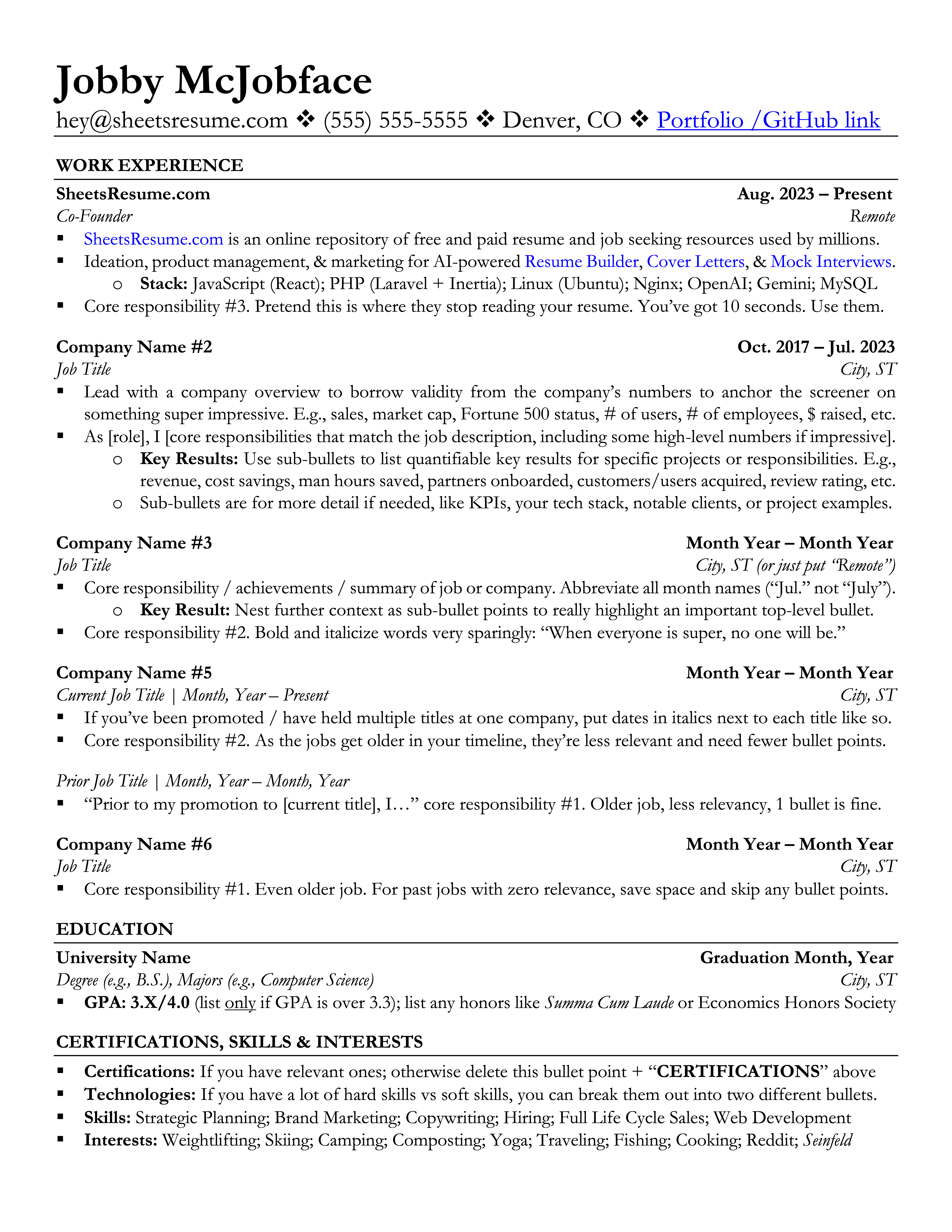
Here's the thing about entry level: everyone applying has roughly the same amount of experience. The ones who get callbacks aren't the ones with the most impressive credentials — they're the ones who present their credentials most clearly. You're not competing against people with more experience. You're competing against people with the same experience who are worse at telling their story. Let's fix that.
Upload My Resume Start with LinkedIn Start from Scratch
4.9★
Average rating
7M+
Resumes created
10 sec
To impress a screener
👩
JESSICA LANG
💻 Software Developer
🌟 Skills
JavaScript★★★★★
React★★★★☆
Leadership★★★★★
📬 Contact
📱 (123) 456-7890
🏆 Awards
🥇 Employee of Month
Jessica Lang
Passionate & Innovative | Problem Solver | Team Player | Change Maker
💡 Creative🚀 Motivated
Results-driven professional with a demonstrated history of delivering impactful solutions. Passionate about leveraging synergistic technologies.
💼 Experience
⚡ Role Title
🏢 Some Company · Jan 2021–Present
Collaborated cross-functionally with diverse stakeholders
Leveraged cutting-edge best practices and agile methodologies
🛠️ Skills
💚 Skill A💚 Skill B💚 Skill C
Sheets Resume Template
Before — the resume that gets ignored
After — click to build yours in seconds! ↑
The 10-Second Rule

What a screener actually looks for on an entry level resume:

The person screening your resume isn't the hiring manager. It's usually someone more junior, working through a stack of applications, looking for basic signal: Did they go to a decent school? Is their degree remotely relevant? Have they held any job, ever? Do their skills match what we need? It takes about ten seconds to answer all four questions. Make it easy to say yes.

What a screener processes in under 10 seconds:
① Most Impressive Credential First
Degree? Internship? Recognizable employer?
Whatever gives you the most credibility leads the resume. If you have a relevant internship or prior job, that goes first. If not, your education leads. Don't bury the lede.
Lead With Your Best Card
② Any Paid Work Experience
Retail? Food service? Campus job?
Any paid job is better than no paid job. Even "irrelevant" work shows you can hold employment, show up, and operate in a professional context. Don't undersell it — describe what you actually did in concrete terms.
Work Is Work
③ Top Bullet
Your single most impressive achievement
Could be from a job, an internship, a class project, a club role, or something you built or created yourself. Lead with the most specific, concrete, quantified version of it you can write. Numbers turn weak bullets into good ones.
Get Specific
④ Skills
MS Office · Google Workspace · CRM · Any software
Entry level candidates almost always undersell this section. If you know a tool, list it. Even things that feel basic — Excel, PowerPoint, Canva, HubSpot — are meaningful signals at this level that you can hit the ground running.
List Everything Relevant
⑤ The Only Goal
A resume doesn't get you a job. It gets you a phone screen. That phone screen is where you make your case as a human being. The resume just needs to clear the bar — and that bar is lower than you think, as long as you clear it cleanly.
Entry level screeners are not expecting a decorated track record. They're expecting a clean, readable document that answers four questions in ten seconds. Obsess less over what you don't have and more over presenting what you do have as clearly as possible.
Get the Phone Screen
What actually works

✅ DO THIS on your entry level resume

  • Lead with your most impressive credential — don't hide it in the middle.
  • Include any paid work experience, even if it feels unrelated.
  • Quantify everything you can: "served 100+ customers daily," "managed $5K event budget."
  • List every relevant skill, tool, software, or platform you actually know.
  • Include an Interests line — entry level interviews almost always touch on it.
  • Keep it to one page. You have plenty of room.

❌ NEVER DO THIS

  • No objective statements. Everyone's "seeking a challenging opportunity." It's meaningless.
  • Don't pad bullets with vague language to fill space. "Assisted with various tasks" is worse than nothing.
  • Don't use a designed or multi-column template — it does not make you stand out, it just confuses parsers.
  • Don't include references on your resume. Nobody is calling them at this stage.
  • Don't list skills you'd be embarrassed to be asked about in an interview.
  • Don't put your high school if you have a college degree (or are currently enrolled).
"
I found Sheets Resume right when I was needing to update my resume and oh my goodness does it work. Not only did it make building my resume quick and easy, but it took the very few words I used and turned them into a more complete and coherent document. If you are just starting out in the job market, this is the tool for you!
Wendell · Line Cook
Common questions

Best Entry Level Resume FAQ

Answered honestly by Colin McIntosh, founder of Sheets Resume Builder and full-time executive recruiter.

How do I write bullet points when I don't have impressive experience?
Start with what you did, then make it as concrete and specific as possible. "Helped customers" becomes "Answered 50+ customer inquiries daily via phone and email, maintaining 4.9/5 satisfaction rating." "Worked the cash register" becomes "Processed 200+ transactions per shift with zero balance discrepancies over 18 months." The experience itself doesn't have to be impressive — the description of it can be. The trick is always: what's the most specific, numbered version of what I actually did?
Should I include a cover letter at the entry level?
Mostly no, but with an important exception. For most online applications, a cover letter is skipped or unread. Don't spend a lot of time on it. The exception is when you have a genuine connection to the company — you used their product, you know someone who works there, you have a specific reason why you want that exact job. In those cases, a short, specific, human cover letter can actually move the needle. "Passionate about joining a fast-growing team" is not that cover letter. Two sentences about why you specifically care about this specific company is.
Should I apply even if I don't meet all the requirements?
Yes — with a caveat. Job postings are wish lists, not contracts. If you meet 60–70% of the requirements, apply. The caveat is that some requirements are real hard stops (specific certifications, clearances, mandatory minimums) and some are nice-to-haves that got copy-pasted from an old posting. Learn to tell the difference. When in doubt, apply. The worst that happens is silence, which is the same as not applying.

Build your entry level resume in minutes — or about 90 seconds if you start with LinkedIn.

Used by entry level candidates across every industry to land their first real roles. Start from any resume, your LinkedIn URL, or from scratch. 4.9 Star Rating, free to try, and no-questions refunds if you don't love it.

Build My Resume with AI 4.9/5 ⭐ Peruse Reviews