Executive Resume Template

The Best Resume for Executives

At the executive level, you're not really submitting a resume — you're submitting a proof of concept. The question the reader is asking isn't "is this person qualified?" It's "is this person someone I'd bet the company on?" That's a different document. From executive recruiters who spend their days placing C-suite, VP-level, and senior leadership at the companies you'd recognize immediately.
Upload My Resume Start with LinkedIn Start from Scratch
4.9★
Average rating
7M+
Resumes created
10 sec
To impress a screener
👩
JESSICA LANG
💻 Software Developer
🌟 Skills
JavaScript★★★★★
React★★★★☆
Leadership★★★★★
📬 Contact
📱 (123) 456-7890
🏆 Awards
🥇 Employee of Month
Jessica Lang
Passionate & Innovative | Problem Solver | Team Player | Change Maker
💡 Creative🚀 Motivated
Results-driven professional with a demonstrated history of delivering impactful solutions. Passionate about leveraging synergistic technologies.
💼 Experience
⚡ Role Title
🏢 Some Company · Jan 2021–Present
Collaborated cross-functionally with diverse stakeholders
Leveraged cutting-edge best practices and agile methodologies
🛠️ Skills
💚 Skill A💚 Skill B💚 Skill C
Sheets Resume Template
Before — the resume that gets ignored
After — click to build yours in seconds! ↑
The 10-Second Rule

What a search firm or board evaluator looks for on an executive resume:

Executive resume screens are different. The reader is often a senior recruiter at a retained search firm, a CHRO, or a board member — someone who has seen thousands of these and has a calibrated sense of what VP-and-above talent actually looks like. They're reading faster than you think, and they're pattern-matching on one question above all else: has this person operated at the scale and complexity this role requires?

What a screener processes in under 10 seconds:
① Company Pedigree
What companies did you build, run, or leave behind?
At the executive level, your company history is your brand. Household names, market-defining companies, meaningful ventures — these are the first thing a search firm evaluates. A company overview bullet is essential for any employer that isn't immediately recognizable: revenue scale, employee count, market position.
Pedigree = First Filter
② Scope & Scale
P&L? Team size? Revenue owned? Market cap?
Executives are evaluated on the size of the problems they've managed. A VP of Sales who owned a $50M quota vs. a $500M quota are completely different hires. P&L responsibility, headcount managed, budget owned, revenue scope — these numbers belong in your top bullets and are often more important than what you achieved.
Scale = Capability Signal
③ Outcomes
Revenue growth · Exits · Transformations · Market share
What changed because of you? Companies and boards hire executives to do something specific: grow revenue, reduce costs, transform culture, launch into new markets, prepare for an exit. Your top bullets should answer "what was the before and after?" as directly as possible.
Outcomes = The Whole Point
④ Board & External Visibility
Board seats · Advisory roles · Press · Speaking
At the VP+ level, external credibility starts to matter in ways it doesn't at other levels. Board seats, advisory roles, thought leadership, press mentions — these belong on an executive resume in a way they wouldn't on a mid-level resume. A brief section at the end works well.
External Credibility
⑤ The One Rule That Changes at the Executive Level
Almost everything we tell other candidates goes double for executives — except the one-page rule. At VP-level and above, two pages is not just acceptable, it's expected. Use them well.
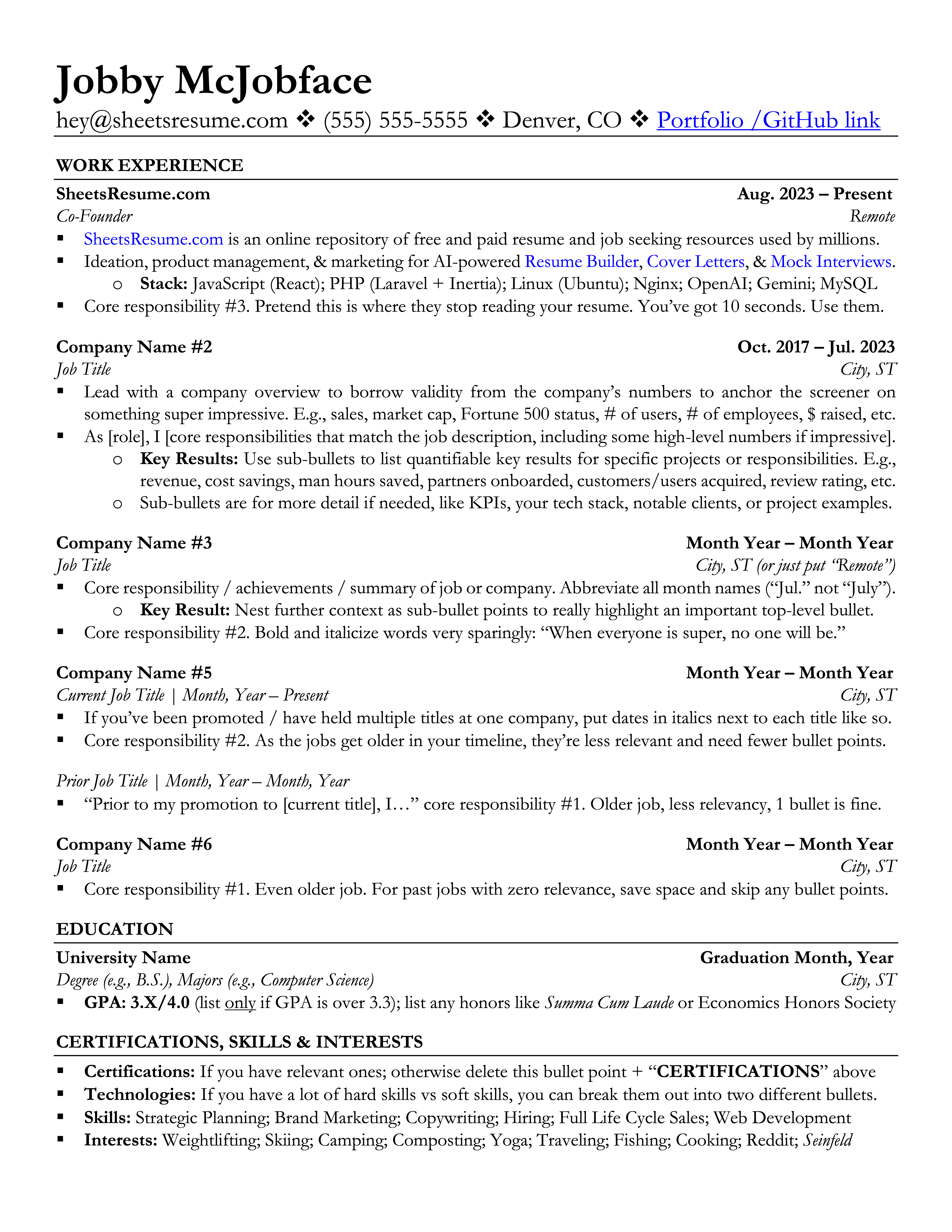
A summary is also acceptable — even recommended — at the executive level, because a brief 2–3 sentence executive summary can contextualize a complex career in a way that pure chronology can't. Keep it tight, make it specific, and lead with scope and outcomes rather than adjectives. Everything else still applies: single column, clean, no icons, no color, no career autobiography.
Two Pages Are Fine. Use Them.
What actually works

✅ DO THIS on your executive resume

  • Lead with P&L ownership, team size, revenue scope, and company scale in your top bullets.
  • Include a brief executive summary (2–3 sentences) if your career path needs context.
  • Use company overview bullets for any employer that isn't a household name.
  • Include board seats, advisory roles, and press/speaking in a dedicated section.
  • Two pages is appropriate and expected at VP-level and above.
  • Quantify exits, transformations, and inflection points — these are what executive searches are built around.

❌ NEVER DO THIS

  • Don't write a three-page resume. Two is the ceiling, even for a 30-year career.
  • Don't bury your most impressive role or outcome midway through. Screeners read top-down, fast.
  • Don't use the same resume for every opportunity — tailor the framing to match what each role needs done.
  • Don't use a designed or multi-column format. The executive resume is the cleanest document in the room.
  • Don't list every job in full detail going back 25 years. Roles older than 15 years get 1–2 lines max.
  • Don't let an AI write your resume and leave it. Executive searches involve people who will ask you about every word.
"
The AI Resume Builder made short work of the task of paring down my overly-wordy, rather jumbled resume, into a single, concise, very readable page, and then made it simple to make adjustments as needed.
Mark · Senior Cloud Engineer
Common questions

Best Executive Resume FAQ

Answered honestly by Colin McIntosh, founder of Sheets Resume Builder and full-time executive recruiter.

Should an executive resume have a summary?
Yes — with caveats. A summary is one of the few cases where we break our "no summary" rule, and it's because executive careers are genuinely complex enough to benefit from orientation. The summary should be 2–3 sentences, not a paragraph. It should lead with scope and outcomes ("20-year operator across SaaS and marketplace businesses; scaled two companies from Series B to exit") not adjectives ("dynamic visionary leader"). If you're writing it and it could apply to anyone, rewrite it.
How far back should my executive resume go?
The last 15 years in full detail. Before that, a brief list of company, title, and dates — no bullets. If you have a particularly impressive early-career role (founded a company, ran a significant P&L very early), you can give it a line or two. The principle is: recency signals relevance. A hiring committee wants to understand what you've been doing lately, and they assume that a 25-year career trajectory is evident from the last 15 years of it.
Should I work with a professional resume writer at the executive level?
It's worth considering for certain searches — specifically if you're targeting a board seat, a PE or VC-backed portfolio company, or a retained search where the document goes through a formal evaluation. That said, our builder is used heavily by VP and C-suite candidates, and the format is exactly what retained search firms and CHROs expect to see. The bigger investment at the executive level is usually your network and your search strategy — not the document itself.

Build your executive resume in minutes. The format is right. The story is yours.

Used by VPs, C-suite executives, and board-level candidates at the world's most recognized companies. Start from any resume, your LinkedIn URL, or from scratch. 4.9 Star Rating, free to try, and no-questions refunds if you don't love it.

Build My Resume with AI 4.9/5 ⭐ Peruse Reviews