Student Resume Template

The Best Resume for Students

You don't have a lot of experience. That's fine — neither did anyone else at your stage. The mistake most students make is trying to hide that fact with a wall of filler. The better move: show screeners exactly what you do have, as cleanly and directly as possible. From executive recruiters who know what hiring managers at top companies actually want to see from students and new grads.
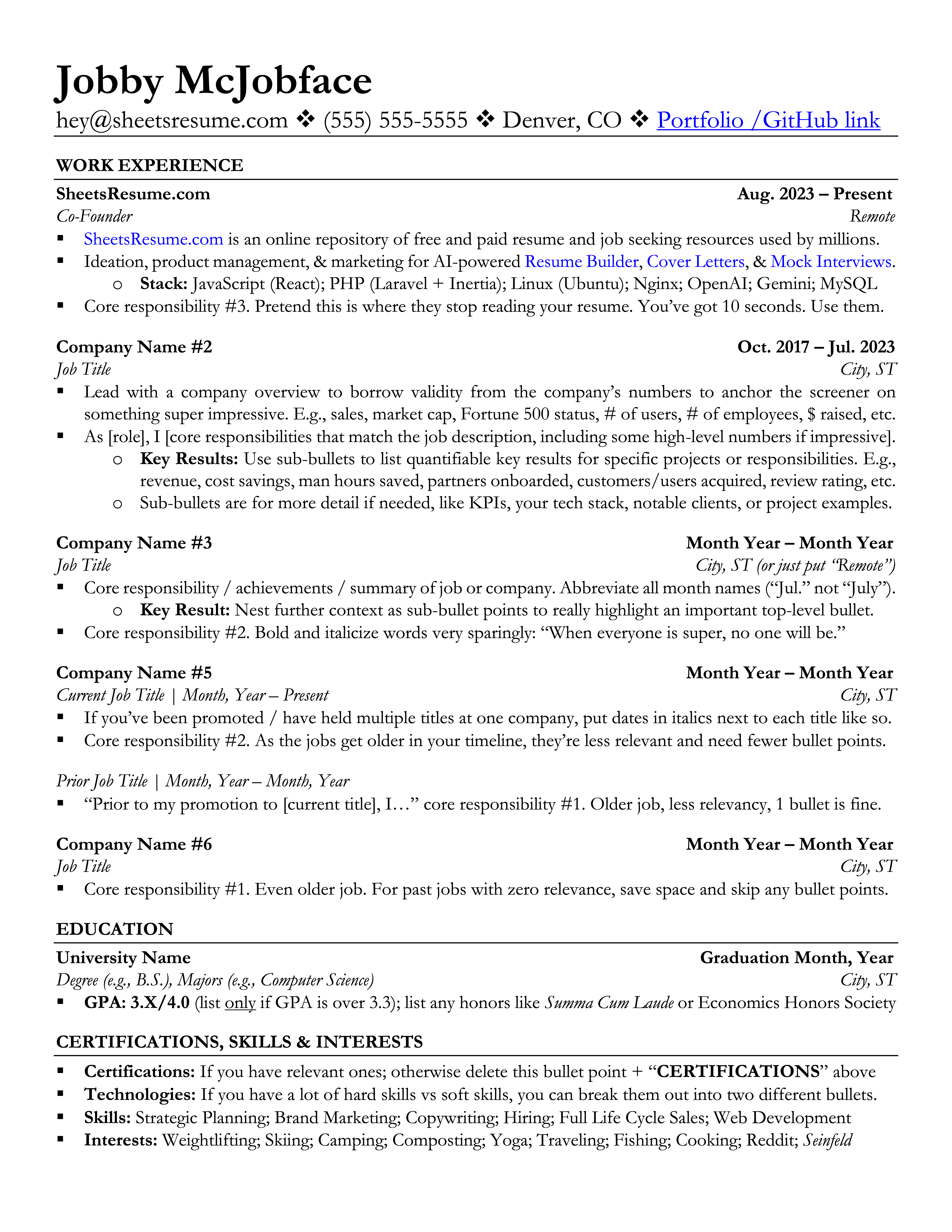
Upload My Resume Start with LinkedIn Start from Scratch
4.9★
Average rating
7M+
Resumes created
10 sec
To impress a screener
👩
JESSICA LANG
💻 Software Developer
🌟 Skills
JavaScript★★★★★
React★★★★☆
Leadership★★★★★
📬 Contact
📱 (123) 456-7890
🏆 Awards
🥇 Employee of Month
Jessica Lang
Passionate & Innovative | Problem Solver | Team Player | Change Maker
💡 Creative🚀 Motivated
Results-driven professional with a demonstrated history of delivering impactful solutions. Passionate about leveraging synergistic technologies.
💼 Experience
⚡ Role Title
🏢 Some Company · Jan 2021–Present
Collaborated cross-functionally with diverse stakeholders
Leveraged cutting-edge best practices and agile methodologies
🛠️ Skills
💚 Skill A💚 Skill B💚 Skill C
Sheets Resume Template
Before — the resume that gets ignored
After — click to build yours in seconds! ↑
The 10-Second Rule

What a screener looks for on a student resume, in order of importance:

The screener reviewing your resume is usually a recruiter or HR coordinator — not the manager you'd be working for. They're checking a list: school, major, GPA (sometimes), experience (internships, part-time jobs, relevant projects), and skills. Ten seconds. They're not expecting a decorated career. They're expecting to see enough signal to put you in the Yes pile for a phone screen.

What a screener processes in under 10 seconds:
① School & Major
UCLA? Michigan? A strong state school?
Your university is your "employer" right now — lead with it if you have nothing stronger. A recognizable school is borrowed credibility. If your school is less well-known, your major and GPA do more work, so make those pop.
Education = Your Current Employer
② Any Relevant Experience
Internship? Part-time job? Lab work?
Even one relevant internship vaults you above most student applicants. If you have one, it goes at the top above your education. If you don't, your education leads, followed by whatever experience you do have — even if it's a campus job, retail, or a research assistant role.
Experience Beats Everything
③ Top Bullet or Project
Built something? Analyzed something? Led something?
Lead with your single best achievement. This could be an internship deliverable, a capstone project, a club leadership role, or a side project with real traction. Quantify wherever possible: "Led a team of 6," "grew club membership 40%," "analyzed dataset of 50,000+ records."
Make It Concrete
④ Skills
Excel · Python · Canva · Salesforce · SQL
Students often undersell their skills section. List every relevant tool or platform you actually know — this is especially important when you have thin experience, because the skills section tells screeners whether you can hit the ground running.
Skills = Your Tech Stack
⑤ The Goal of a Student Resume
Everyone applying alongside you also has thin experience. The ones who get calls are the ones who present what they have most clearly — not the ones who bury mediocre experience under fancy formatting and buzzword summaries.
Your resume is a blunt tool to land a phone call. It doesn't need to tell your whole story — it just needs to give a screener enough signal to put you in the Yes pile. Make it easy. Keep it clean. Let the interview tell the rest.
Get the Interview
What actually works

✅ DO THIS on your student resume

  • Put your GPA if it's 3.5 or above. Below that, leave it off.
  • Include any internship — even one semester changes everything.
  • List relevant coursework if you're light on experience and the classes are genuinely relevant.
  • Include campus clubs, organizations, or leadership — especially anything with numbers behind it.
  • Keep it to one page. You have enough room, I promise.
  • End with an Interests line. It's often the thing that actually gets you remembered.

❌ NEVER DO THIS

  • No objective statements. "Seeking a challenging opportunity to apply my skills…" gets you skipped immediately.
  • Don't use a multi-column or designed template — it reads as trying too hard and breaks ATS parsers.
  • Don't pad your experience with vague descriptions. "Assisted with various tasks" tells a screener nothing.
  • Don't list high school accomplishments if you're a junior, senior, or recent grad. Let it go.
  • Don't put your GPA if it's under 3.5 — just leave it blank.
  • Don't include references. Nobody asked.
"
Handy tool as a student. Helps me achieve possibilities that were not achievable before using Sheets Resume.
Roni · Student
Common questions

Best Student Resume FAQ

Answered honestly by Colin McIntosh, founder of Sheets Resume Builder and full-time executive recruiter.

What do I put on my resume if I have no experience?
More than you think. Education (school, major, GPA if it's strong, graduation date). Relevant coursework, if the classes are actually applicable to the job. Campus clubs, organizations, or teams — especially if you held a leadership role. Any part-time jobs, even if they're not in your target field (retail, food service, etc. all demonstrate reliability and people skills). Academic or personal projects, especially if they're technical or creative and have something concrete to show for them. Volunteer work. And skills — every piece of software, platform, or tool you know how to use. You have more than you think. The key is presenting all of it cleanly, without fluff.
Should I put my GPA on my resume?
If it's 3.5 or above: yes, put it right next to your degree. If it's between 3.0 and 3.49: use your judgment — some industries (finance, consulting) care more than others (tech, creative). If it's below 3.0: leave it off entirely. Nobody is going to ask "why isn't your GPA on here?" But they will notice a 2.6 and wonder if you're a strong candidate. The absence of a GPA is neutral. A low GPA is a mild negative signal. Easy call.
Should I put my high school on my resume?
Only if you're a freshman or sophomore in college and your high school accomplishments are genuinely relevant (prestigious school, major award, varsity something). By junior year of college, your high school is fully off the resume. By graduation, it should have been gone for two years. Once you have a college degree, high school is just noise — and it signals that you don't have enough college experience to fill the space, which is the last thing you want.

Build your student resume in minutes. (Seriously — start with your LinkedIn and it takes about 90 seconds.)

Used by students and new grads from hundreds of universities to land internships and first jobs. Start from any resume, your LinkedIn URL, or from scratch. 4.9 Star Rating, free to try, and no-questions refunds if you don't love it.

Build My Resume with AI 4.9/5 ⭐ Peruse Reviews